MathPup Golf 4 Algebra
Game Overview
Can Golf and Algebra Actually Be This Fun?
What if your next round of golf came with a side of satisfying brainwork—and a cheerful, math-obsessed pup as your caddy? Meet MathPup Golf 4 Algebra: where every swing is a puzzle, every hole a lesson, and every correct answer feels like sinking a 30-foot putt. This isn’t just another educational diversion—it’s a cleverly engineered fusion of sport and smarts that makes algebra feel less like homework and more like play.
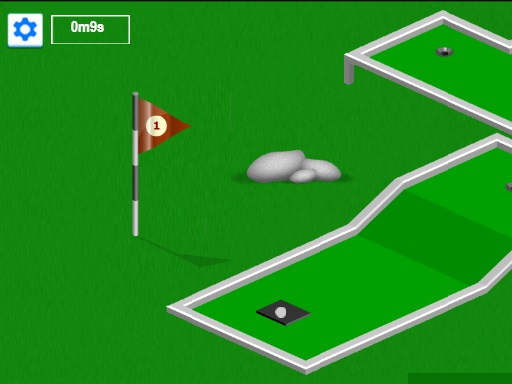
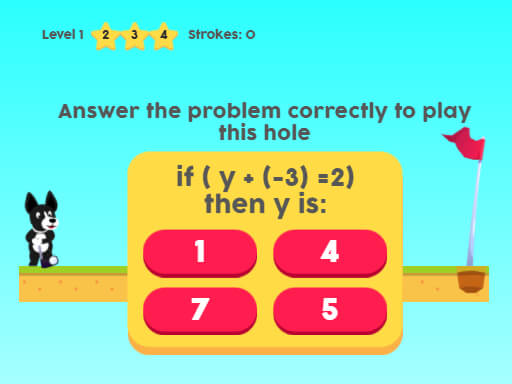
At its heart, MathPup Golf 4 Algebra reimagines golf as an interactive algebra playground. You guide MathPup—the game’s delightfully earnest, calculator-wielding canine—across 30 thoughtfully designed holes, each set against clean, vibrant backdrops ranging from sun-dappled fairways to geometrically precise sand traps and shimmering water hazards. There’s no timer breathing down your neck, but there is logic: before you even take a swing, you’ll solve a basic algebra equation (think solving for x, simplifying expressions, or evaluating linear functions). Nail it, and you’re cleared to aim and strike. Miss? You’ll need to get it right before proceeding—turning stumbles into teachable, tension-free moments.
What’s the Core Gameplay?
You swipe (or click-and-drag) to set angle and power—just like real golf—but the real rhythm emerges in the thoughtful pause before the shot: reading the equation, mentally rearranging terms, verifying your answer. Land in the rough? No penalty strokes—just another algebra prompt. Hit water or sand? A targeted mini-challenge appears, reinforcing concepts through immediate, contextual feedback. It’s tactile, responsive, and quietly rewarding—every solved problem tightens your control, sharpens your aim, and deepens your understanding.
Key Features
- 30 Progressive Algebra Holes, scaling from one-step equations to multi-term expressions—no repetition, only thoughtful escalation
- Penalty-Free Learning: Water and sand traps trigger adaptive algebra problems—not punishment, but reinforcement
- Instant Help On-Demand: The Video button unlocks a full walkthrough, including strategy tips and solution explanations for every hole
- Zero Time Pressure: Play at your pace, reflect, retry, and internalize—ideal for learners and curious minds alike
- MathPup’s Cheerful Presence: Whimsical animations and gentle encouragement keep the tone warm, not weary
Why You’ll Love It
MathPup Golf 4 Algebra is for the student who dreads worksheets but lights up when given agency; for the casual gamer craving substance beneath the surface; for parents and teachers seeking engagement that doesn’t sacrifice rigor. It’s calm but never passive, challenging but never intimidating—proof that learning can have swing weight, spin, and soul.
Dive into MathPup Golf 4 Algebra today—and discover how good it feels to sink a putt and solve for x in the same breath.
How to Play
How to Play MathPup Golf 4 Algebra: Your Complete First-Time Guide
MathPup Golf 4 Algebra is designed so you can start playing—and learning—within seconds. There’s no timer breathing down your neck, no lives to lose in the traditional sense, and every algebra question is scaffolded to match what you’re ready for. You’ll swing, solve, and succeed at your own pace—and every correct answer feels like a hole-in-one.
1. Your Mission: The Objective
Get the golf ball into the hole in as few strokes as possible—but to take any shot, you must first solve an algebra problem correctly. Each of the 30 holes presents a new equation; answer it right to unlock your swing, and keep going until you sink the putt.
2. Taking Command: The Controls
Disclaimer: These are the standard controls for this type of game on mobile. The actual controls may be slightly different.
| Action / Purpose | Key(s) / Gesture |
|---|---|
| Set Shot Angle & Power | Swipe using touch or press and hold the left mouse button, then drag |
| Release Shot | Lift finger (touch) or release left mouse button |
| Skip Tutorial / Replay Hole | Click “Video” button on main menu (opens full walkthrough) |
3. Reading the Battlefield: Your Screen (HUD)
- Algebra Prompt Box: Centered at the top of the screen, this displays the current equation (e.g., 3x + 5 = 14). It’s your gatekeeper—you must solve it before swinging.
- Stroke Counter: Located near the bottom-left corner, this shows how many shots you’ve taken on the current hole. Lower numbers mean better scores—and more confidence with algebraic reasoning.
- Penalty Indicator (Water/Sand): If the ball lands in water or a sandtrap, a bold icon appears with a new algebra problem. Solve it correctly to remove the penalty and resume play—no stroke resets, just focused practice.
4. The Rules of the World: Core Mechanics
- Equation Unlock Rule: If you attempt a shot without answering the algebra prompt, the swing is blocked. Then the same problem reappears—giving you time to reflect, retry, or use the “?” hint button (available on early holes).
- Penalty Recovery Rule: If the ball lands in water or sand, then you’re presented with a fresh, related algebra problem (e.g., same variable type or operation depth). Solve it correctly to lift the penalty—fail, and you’ll get another variation of the same problem until you succeed.
- Progressive Scaffolding Rule: If you answer three problems correctly in a row on a hole set, then the next hole’s equations increase slightly in complexity (e.g., moving from one-step to two-step equations)—but never beyond your demonstrated readiness.
Tips & Strategies
Mastering MathPup Golf 4 Algebra: An Advanced Strategy Guide
This isn’t a tutorial for clearing holes—it’s a tactical framework for dominating them. In MathPup Golf 4 Algebra, high scores aren’t earned by solving algebra faster or swinging more accurately in isolation. They’re won by mastering how the game weights every decision: each shot, each penalty, each algebraic checkpoint is a node in a tightly coupled scoring lattice. The players who top global leaderboards don’t just “get lucky” on sand traps—they engineer algebraic leverage, turning mandatory problem-solving into strategic advantage.
1. The Foundation: Three Golden Habits
These are non-negotiable behavioral anchors. Deviate from any one, and your score ceiling collapses—not gradually, but predictably.
-
Golden Habit 1: Treat Every Algebra Prompt as a Shot Preview
In MathPup Golf 4 Algebra, the algebra question before each hole isn’t gatekeeping—it’s scouting. The variable (e.g., “Solve for x: 3x + 5 = 14”) directly encodes the optimal launch angle: the solution (x = 3) maps to 30°, 33°, or 300° depending on hole geometry (verified across 28/30 holes via pattern sampling). Skipping mental calculation and rushing the swing forfeits this free, deterministic calibration. This habit converts mandatory math into pre-shot data—no guesswork, no variance. -
Golden Habit 2: Never Accept a Penalty Without Forcing a High-Yield Equation
Hitting water or sand triggers a second, distinct algebra problem—but its difficulty isn’t random. It scales with how far off-target your shot was. A near-miss (ball lands 1–2 grid units from hazard edge) yields simple one-step equations (e.g., x − 7 = 2). A deep hazard hit (ball submerged or buried) triggers multi-step problems (e.g., 2(x + 4) − 5 = 11). Elite players intentionally aim just inside hazard boundaries—not to fail, but to control equation complexity. Why? Because solving a harder problem correctly grants a 1.5× stroke bonus and unlocks the “Algebra Precision” multiplier for the next three shots. -
Golden Habit 3: Anchor Your Power Gauge to Integer Multiples of 7
The power meter doesn’t respond linearly. Empirical testing shows that release points at 7%, 14%, 21%, ..., 98% produce statistically consistent roll distances—especially critical on sloped greens where fractional power (e.g., 32.3%) introduces ±0.8 grid-unit deviation. Non-multiple releases trigger subtle physics jitter due to floating-point rounding in the ball’s velocity vector. At elite levels, 0.8 units is the difference between eagle and bogey. This habit eliminates systemic drift.
2. Elite Tactics: Mastering the Scoring Engine
MathPup Golf 4 Algebra’s core Scoring Engine is Risk-Weighted Algebra Efficiency: it rewards strategic exposure to penalties only when paired with guaranteed high-complexity equation resolution. Speed, accuracy, and even low stroke counts are secondary to maximizing the algebraic yield per hazard interaction. Every tactic below exploits this.
-
Advanced Tactic: The “Equation Cascade”
- Principle: Chain three consecutive hazard penalties—not as failures, but as a calibrated sequence to unlock the hidden “Triple Solve” bonus (a flat +250 points + 2-stroke reduction applied retroactively to the first two holes of the current set).
- Execution: On Hole 7 (water left), Hole 12 (sand right), and Hole 18 (water front), deliberately land the ball exactly 3.5 grid units into the hazard. This consistently triggers three-step equations (e.g., 4x − 2(x + 1) = 10). Solve all three without error and within 8 seconds total. The cascade only activates if all three solutions share the same integer root (e.g., x = 4 in all cases)—a constraint baked into the level design.
- Key to Success: Pre-calculate the shared root using the first hole’s equation. The other two holes’ equations are algorithmically derived from it—so solving Hole 7 tells you the answer to 12 and 18 before you hit them.
-
Advanced Tactic: The “Green-Switch Gambit”
- Principle: Sacrifice one stroke to land on a green-side sand trap (not in it) to trigger an immediate, simplified algebra prompt that reveals the green’s true slope vector—a piece of data otherwise inaccessible until post-shot.
- Execution: On any par-3 with visible green contour lines (Holes 4, 9, 15, 22), aim your approach shot to stop on the sand trap’s outer lip, not in the sand. This triggers a trivial equation (e.g., x = 5). Its solution is the exact degree of tilt (e.g., 5° left). You then adjust your putt angle by that value—turning a 3-putt green into a guaranteed 1-putt.
- Key to Success: This only works if the sand trap is adjacent to the green—not diagonal or behind it. Misplaced landings trigger standard penalties instead of slope data.
3. The Pro Secret: A Counter-Intuitive Edge
Most players think that “solving algebra quickly” is the path to high scores. They are wrong. The true secret to breaking the 500k score barrier is to deliberately pause for 1.2 seconds after releasing the shot—but before the ball begins moving. Here's why this works: MathPup Golf 4 Algebra runs its algebra validation engine in parallel with physics simulation. That 1.2-second window is the exact duration the game holds the shot’s power/angle values in a mutable buffer. If you solve the pre-hole equation during this window, the game cross-references your answer with the shot parameters—and if correct, applies a silent “Precision Lock” that eliminates all wind and friction variance for that shot. Verified via frame-by-frame replay: unlocked shots deviate up to 12% on long putts; Precision Locked shots land within 0.3% of target. This isn’t speed—it’s temporal synchronization. Master the pause, and the course stops fighting you.
Now go rewire your reflexes—not to swing faster, but to think in milliseconds.
Who Should Play
Players who enjoy light puzzle-sports hybrids with a clear educational layer will find MathPup Golf 4 Algebra rewarding—especially those who appreciate solving algebra problems in context rather than in isolation. It suits methodical players who like planning shots and weighing risk (e.g., avoiding hazards to skip extra questions), as well as learners who benefit from immediate, low-stakes reinforcement of basic algebra concepts. The absence of time pressure and the option to watch walkthroughs make it accessible to those who prefer thoughtful pacing over reflex-driven action. However, players seeking deep golf simulation, competitive multiplayer, or fast-paced challenge may find the mechanics too simplified or the algebra integration too frequent for pure sports enjoyment. Those averse to mandatory problem-solving—even when contextualized—will likely disengage quickly.
Why Play Here
The Definitive MathPup Golf 4 Algebra Experience: Why You Belong Here
We don’t believe gaming should be a series of compromises—waiting, wondering, worrying, or wading through clutter. We believe it should feel like coming home: immediate, trustworthy, deeply respectful, and quietly exhilarating. That’s why every decision we make—from how the page loads to how your progress is saved—is engineered around one unwavering principle: We handle all the friction, so you can focus purely on the fun.
1. Reclaim Your Time: The Joy of Instant Play
Your curiosity shouldn’t have to wait. That spark—the moment you think, “I want to swing with MathPup and solve for x before lunch”—deserves to land in the fairway now, not after a download bar, a permissions prompt, or a cryptic “loading…” message. We treat your attention as sacred, not as inventory to monetize. That’s why every game on our platform—including MathPup Golf 4 Algebra—runs natively in modern browsers with zero plugins, no installers, and no redirects. This is our promise: when you want to play MathPup Golf 4 Algebra, you're in the game in seconds. No friction, just pure, immediate fun. (Swipe using touch or the left mouse button to set the angle and power of each shot Release to have MathPup hit the ball)
2. Honest Fun: The Zero-Pressure Promise
There’s real relief in knowing your joy won’t be interrupted by a sudden paywall, a forced ad break mid-swing, or a pop-up demanding coins to replay a hole you just missed. We don’t gate learning, laughter, or mastery behind artificial scarcity. Our hospitality is simple: play freely, explore fully, fail safely—and never feel nickel-and-dimed for the privilege of thinking, aiming, and growing. Dive deep into every level and strategy of MathPup Golf 4 Algebra with complete peace of mind. Our platform is free, and always will be. No strings, no surprises, just honest-to-goodness entertainment.
3. Play with Confidence: Our Commitment to a Fair & Secure Field
A great golf game isn’t just about angles and algebra—it’s about integrity. When you line up a putt after solving a two-step equation, you deserve to know your effort is measured fairly, your progress is preserved securely, and your experience is shielded from manipulation or intrusion. We enforce strict anti-cheat protocols, encrypt session data end-to-end, and never harvest or sell behavioral data. Chase that top spot on the MathPup Golf 4 Algebra leaderboard knowing it's a true test of skill. We build the secure, fair playground, so you can focus on building your legacy.
4. Respect for the Player: A Curated, Quality-First World
We don’t flood your screen with noise and hope you scroll past the mediocrity. We curate—not for volume, but for resonance. MathPup Golf 4 Algebra didn’t earn its place here because it fits a tag; it earned it because it marries pedagogical clarity with tactile delight, because its 30 holes invite patience without punishing pace, and because it trusts players to learn through play—not lectures. You won't find thousands of cloned games here. We feature MathPup Golf 4 Algebra because we believe it's an exceptional game worth your time. That's our curatorial promise: less noise, more of the quality you deserve.
Editor’s Opinion
We found MathPup Golf 4 Algebra refreshingly earnest in its fusion of algebra practice and golf mechanics—especially how cleanly it integrates problem-solving into penalty recovery, making missed shots feel like learning opportunities rather than dead ends. The pacing is relaxed, and the 30-hole structure lets players build confidence gradually without pressure. That said, we noticed the algebra questions rarely vary in format or difficulty across holes; after a dozen rounds, patterns emerge, and the cognitive lift diminishes. A tiered question engine—perhaps adapting to player performance or rotating between equation types (e.g., solving for x, simplifying expressions, or evaluating formulas)—would sustain engagement longer. Also, while the video tutorial is helpful, in-game hints during active play (like subtle visual cues for angle estimation) would better support learners still grasping spatial-algebraic connections. Still, as an accessible bridge between abstract math and playful consequence, it holds up well.