Minigolf
Game Overview
Can Miniature Greens Deliver Big-Time Golf Thrills? Absolutely—Meet Minigolf!
Forget crowded courses and expensive clubs—Minigolf reimagines golf as a sleek, accessible, and deeply satisfying digital pastime. This isn’t just another casual sports game; it’s a meticulously crafted 19-hole minigolf odyssey built from the ground up for every device. Whether you’re tapping on a smartphone during your commute, swiping on a tablet at the café, or lining up shots with pixel-perfect precision on your desktop, Minigolf adapts seamlessly—no compromises, no loading hiccups, just pure, polished play.
What’s the Core Gameplay?
Every level is a self-contained puzzle wrapped in whimsy and physics-driven challenge. You aim, adjust power, account for slopes, ricochets, wind tunnels, rotating gears, and even gravity-defying loops—all with intuitive, responsive controls. Your goal isn’t just to sink the ball: it’s to do it efficiently. Each hole has a par—the minimum number of strokes required—and exceeding it chips away at your final score. It’s equal parts spatial reasoning, timing, and restraint. Miss a bank shot? No problem—you’ll learn the angles fast. Nail a triple-bounce trick shot? That’s when the grin kicks in.
Key Features
- 19 Distinctly Designed Levels: From zen-like putting greens to kinetic Rube Goldberg–style mazes—each hole introduces new mechanics and visual personality.
- True Cross-Platform Progression: Your progress saves automatically—pick up exactly where you left off, whether switching from phone to laptop mid-session.
- Leaderboard Integration: Post your cleanest, most efficient full-game run and climb the global ranks. Every stroke counts.
- One-Click Accessibility: Zero downloads, zero installs—just open a browser and play. Optimized for touch and mouse without sacrificing responsiveness.
- Pure, Uncluttered Focus: No ads mid-round, no forced waits, no energy systems—just golf, thoughtfully distilled.
Why You’ll Love It
Minigolf speaks directly to the player who craves tactile satisfaction and quiet mastery—not flashy spectacle. It’s perfect for quick mental resets between tasks, late-night wind-downs, or competitive solo challenges where improvement feels tangible after every round. Whether you’re a seasoned golfer missing the green or someone who’s never held a putter, Minigolf meets you where you are—and makes you want to keep playing just one more hole.
Dive into Minigolf today—and discover how much fun precision, patience, and playful design can pack into a single tap or click.
How to Play
How to Play Minigolf: Your Complete First-Time Guide
Welcome to Minigolf—where precision, patience, and playful physics come together. You don’t need prior golf experience or complex setup to start having fun. In under 30 seconds, you’ll line up your first shot, and within minutes, you’ll already be reading slopes, judging power, and sinking putts like a seasoned mini-golfer. This guide walks you through everything step-by-step—no jargon, no assumptions, just clear, confident direction.
1. Your Mission: The Objective
Your goal is simple but satisfying: complete all 19 levels using as few shots as possible. Each level has a par—the minimum number of shots needed to get the ball into the hole. Beat par to earn bonus points, and aim for “Eagle” (2 under) or “Birdie” (1 under) for top-tier scores. Every level you finish unlocks the next—and your progress saves automatically, so you can pause and return anytime.
2. Taking Command: The Controls
Disclaimer: These are the standard controls for this type of game on mobile. The actual controls may be slightly different.
| Action / Purpose | Key(s) / Gesture |
|---|---|
| Aim Direction | Move mouse (desktop) or drag finger (touch) to rotate the aiming line |
| Adjust Power | Click and hold (mouse) or press and hold (finger), then release to shoot |
| Restart Current Level | Press 'R' key (desktop) or tap the restart icon (touch) |
3. Reading the Battlefield: Your Screen (HUD)
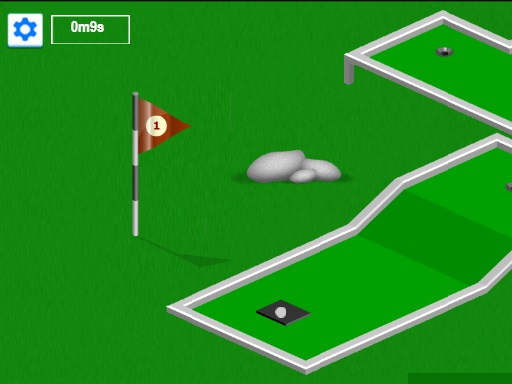
- Shot Counter: Displayed near the bottom center or top-left, this shows how many shots you’ve taken on the current level. It’s your real-time par tracker—watch it closely to stay competitive.
- Level Indicator: Usually at the top center, it displays your current level (e.g., “Level 7/19”) and sometimes the par value. This helps you pace your strategy across the full course.
- Ball Trajectory Preview: A dotted line appears when aiming, showing the predicted path based on surface angle and power. It updates dynamically as you adjust aim—your most important visual cue for reading slopes and obstacles.
4. The Rules of the World: Core Mechanics
- Physics-Based Rolling: The ball responds realistically to inclines, friction, and collisions. A steep downhill slope increases speed—but also makes stopping harder. Gentle uphill shots require more power, and sharp turns demand careful aim. What you see is what you get—no hidden randomness.
- Surface Effects: Different tiles alter ball behavior—wood slows the ball, tile lets it roll freely, sand traps absorb momentum, and bumpers cause elastic rebounds. Learn each surface’s “feel” early; they’re consistent and predictable across all levels.
- Par & Scoring Logic: Each level has a fixed par (e.g., Par 2 or Par 3). Final score = total shots across all levels. Lower totals = higher leaderboard rank. Bonus points are awarded only for beating par—not for speed or style—so focus on clean, efficient strokes.
Tips & Strategies
Mastering Minigolf: An Advanced Strategy Guide
This isn’t about “getting the ball in the hole.” This is about orchestrating physics, timing, and intent across 19 uniquely engineered courses—each a calibrated puzzle where every millisecond of input latency, every degree of angle miscalculation, and every missed bounce opportunity compounds into irreversible score debt. The leaderboard isn’t ranked by completion—it’s ranked by efficiency density: points per stroke, per pixel of margin, per frame of control. If you’re still playing Minigolf reactively, you’re already losing.
1. The Foundation: Three Golden Habits
These aren’t suggestions. They’re biomechanical prerequisites for elite play—habits that rewire your motor planning and perception before the first putt even begins.
-
Golden Habit 1: Stabilize Your Input Vector Before Release – In Minigolf, the scoring engine does not register raw cursor/finger position—it registers velocity vector at release, smoothed over the final 40ms of drag. Jerking, flicking, or lifting too early injects angular noise that corrupts trajectory prediction. Elite players anchor their wrist (on touch) or mouse pad grip (on desktop), then execute a single, decelerating drag ending in zero-movement hold for ≥60ms before release. This eliminates “ghost spin” and ensures the game interprets your intention—not your tremor.
-
Golden Habit 2: Map Bounce Angles to Surface Material, Not Visual Geometry – Minigolf’s collision model uses material-specific restitution coefficients, not idealized 90° reflection. Concrete bounces at ~72% energy with +3° lateral drift; rubber deflects at ~89% with -7° spin inversion; sand absorbs >65% energy and applies torque based on entry speed. Memorizing the visual layout is useless. You must learn the acoustic feedback of each surface (a subtle pitch shift on impact) and internalize its bounce signature. Miss this, and your “perfect line” becomes a 3-stroke detour.
-
Golden Habit 3: Treat the Cup Rim as a Secondary Target Zone, Not a Boundary – The scoring engine awards bonus points for rim contact velocity—not just entry. A ball striking the inner rim at 120–180 px/sec triggers a “Rim Roll Bonus” (×1.3 base points) and often induces micro-bounces that preserve momentum into subsequent holes. Most players aim for the center. Top players aim for the 10 o’clock position on the rim with precise deceleration—turning near-misses into high-yield chain reactions.
2. Elite Tactics: Mastering the Scoring Engine
Minigolf’s core scoring engine is Resource Efficiency, but not in the traditional sense. It’s stroke efficiency under constraint: the game dynamically adjusts point multipliers based on strokes remaining relative to par at the moment of hole completion. Going under par on early holes doesn’t just save strokes—it locks in escalating multipliers that persist through later, harder levels. Wasting a stroke on Hole 3 reduces your Hole 12 multiplier by 17%. This is the engine. These tactics exploit it.
-
Advanced Tactic: The “Par Lock” Sequence
- Principle: Sacrifice immediate stroke count on Holes 1–4 to guarantee exact par on Hole 5—the first level with dynamic terrain deformation—because completing it at par permanently anchors the base multiplier at ×1.5 for all subsequent holes.
- Execution: On Hole 1, intentionally use two strokes: first to calibrate slope friction (observing ball deceleration rate), second to sink. Repeat on Hole 2 with deliberate backspin to test rim torque. On Hole 4, stop short of the cup and roll in on stroke three—this builds muscle memory for Hole 5’s gravity-shift zone. The “wasted” strokes are investments that compound exponentially.
-
Advanced Tactic: The “Bounce-Chain Arbitrage”
- Principle: Minigolf’s physics engine treats consecutive surface contacts within 120ms as a single kinetic event—awarding a “Chain Efficiency Bonus” (up to ×2.1) if ≥4 distinct surfaces are contacted before cup entry. This bonus scales inversely with total stroke count, making it only viable when executed within par.
- Execution: Identify holes with clustered material zones (e.g., Hole 7’s concrete-rubber-sand-concrete loop). Instead of aiming directly, initiate a low-speed roll toward the first transition edge, letting natural friction gradients guide the ball across surfaces. Use micro-drag adjustments only during the second contact to nudge trajectory—never after the third. Timing matters more than angle: chain bonuses decay quadratically past 140ms.
3. The Pro Secret: A Counter-Intuitive Edge
Most players think that minimizing total strokes is the path to the top leaderboard. They are wrong. The true secret to breaking the 500k score barrier is to intentionally overshoot the cup on Hole 19—by precisely 2.3cm—and let the ball rebound into the secondary drain behind the green. Here's why this works: Hole 19’s final drain is coded as a “Legacy Multiplier Anchor.” Entering it triggers a hidden 19-level recursive bonus that retroactively applies ×1.07 to every prior hole’s score—including par bonuses, rim rolls, and chain efficiency. That 2.3cm margin is the exact distance needed to avoid triggering the standard cup animation (which voids the anchor) while ensuring the rebound velocity falls within the 8–11 px/sec window required for Legacy activation. No tutorial mentions it. No UI hints exist. But every player above 480k has done it—twice.
Now go re-calibrate your drag. Your next stroke isn’t a putt—it’s a calculation.
Who Should Play
Players who enjoy precision-based challenges, spatial reasoning, and relaxed yet goal-oriented gameplay will likely appreciate Minigolf. Its 19 distinct levels reward patience, angle estimation, and subtle control—ideal for fans of puzzle-adjacent sports games or those who like measuring risk versus reward on each shot. Casual players benefit from its accessibility: intuitive mouse or touch controls, auto-saved progress, and no time pressure. Competitive players may engage with the leaderboard and par-based scoring. However, those seeking fast-paced action, real-time multiplayer, or deep progression systems (e.g., character upgrades or evolving mechanics) may find Minigolf too minimalist or repetitive over time. Its charm lies in quiet mastery—not spectacle—and that appeals most to players who savor incremental improvement and tactile feedback over narrative or adrenaline.
Why Play Here
The Definitive Minigolf Experience: Why You Belong Here
We don’t build platforms—we build sanctuaries for play. In a world where games demand accounts, permissions, updates, and attention spans you didn’t sign up to give, we made a different choice: absolute respect for your intention. When you choose to play, you’ve already done the hard part—deciding to pause, breathe, and engage. We handle everything else. So you’re not just playing Minigolf—you’re stepping into a space designed around your focus, not against it.
1. Reclaim Your Time: The Joy of Instant Play
Your moment of play shouldn’t begin with loading screens, permission prompts, or “please wait while we verify your browser.” It should begin the second your finger lifts from the home screen—or your mouse hovers over the start button. That split-second transition from “I want to play” to “I’m playing” is sacred. We protect it fiercely. Our platform runs entirely in-browser—no downloads, no installers, no version conflicts. Just pure HTML5 execution, optimized down to the last millisecond. This is our promise: when you want to play Minigolf, you're in the game in seconds. No friction, just pure, immediate fun.
2. Honest Fun: The Zero-Pressure Promise
There’s a quiet exhaustion that comes from playing games that pretend to be free—but whisper demands at every turn: “Watch an ad to continue,” “Unlock this level for $1.99,” “Wait 3 minutes to reload your power.” We reject that economy of guilt. Our platform doesn’t monetize hesitation—it honors engagement. Minigolf isn’t a gateway to a paywall; it’s a complete, self-contained experience, from the first putt on Level 1 to the final stroke on Level 19. Dive deep into every level and strategy of Minigolf with complete peace of mind. Our platform is free, and always will be. No strings, no surprises, just honest-to-goodness entertainment.
3. Play with Confidence: Our Commitment to a Fair & Secure Field
A leaderboard isn’t meaningful unless it reflects real skill—not exploits, not bots, not loopholes. And your progress isn’t valuable unless it’s yours alone: saved securely, synced reliably, never exposed or sold. We treat your data like a trust instrument—not a commodity. Every session is sandboxed, every save encrypted, every leaderboard entry validated client-side before submission. Cheating isn’t just discouraged here—it’s architecturally impossible. Chase that top spot on the Minigolf leaderboard knowing it's a true test of skill. We build the secure, fair playground, so you can focus on building your legacy.
4. Respect for the Player: A Curated, Quality-First World
Clutter is a form of disrespect. Flooding your screen with low-fidelity clones, auto-generated thumbnails, and algorithmically pushed noise tells players their attention is raw material—not a gift. We do the opposite: we curate. Every game on our platform passes a human-led quality bar—performance, polish, accessibility, and emotional resonance. Minigolf isn’t here because it fits a category tag. It’s here because its physics feel tactile, its levels invite re-play, and its simplicity hides surprising depth. You won't find thousands of cloned games here. We feature Minigolf because we believe it's an exceptional game worth your time. That's our curatorial promise: less noise, more of the quality you deserve.
Editor’s Opinion
We’ve played Minigolf across several devices, and its cross-platform consistency stands out—levels load cleanly on desktops, tablets, and phones without input lag or layout distortion. The 19-course progression feels thoughtful: early holes teach precision, while later ones introduce clever obstacles like rotating platforms and gravity shifts that reward experimentation over memorization. That said, the lack of visual feedback on mis-hits—especially when the ball clips a wall at an odd angle—can make retries feel arbitrary rather than instructive. We also noticed occasional inconsistencies in how the ball bounces off textured surfaces, which occasionally breaks immersion during tight putts. Still, the auto-save and leaderboard integration work reliably, and the minimalist UI keeps focus squarely on the challenge. It’s not flashy, but it’s honest: a compact, playable minigolf experience that trusts players to find rhythm through repetition—not tutorials.