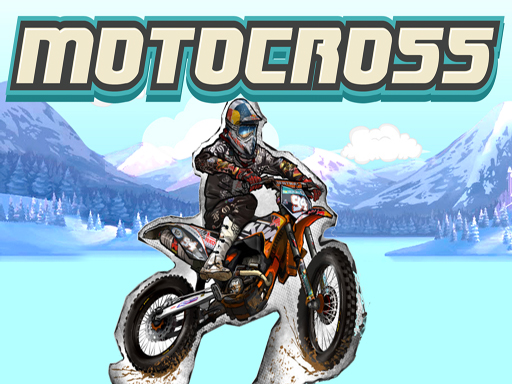
Motocross
Game Overview
Ride the Edge: Motocross Is Snow Racing Reimagined!
What happens when you swap asphalt for ice, throttle for precision, and speed for split-second aerial control? You get Motocross — a razor-sharp, physics-driven snowbike racer that turns winter into a playground of momentum, mayhem, and mastery.
Motocross isn’t just another racing game — it’s a tightly crafted, eight-stage odyssey across treacherous alpine terrain where gravity is optional and timing is everything. You’re not cruising; you’re commanding a high-torque motorcycle over frozen rivers, wind-scoured ridges, and crumbling glacial plateaus. That “brief description” barely scratches the surface: this is a game where every jump matters, every landing recalibrates your rhythm, and every level demands evolving reflexes — not just faster fingers, but smarter spatial awareness.
Moment-to-moment, gameplay is deceptively simple yet deeply expressive: tap or press arrow keys (or swipe on touch screens) to accelerate, brake, and tilt mid-air. But the real magic unfolds in the air — you’ll time jumps off icy ramps, adjust bike angle mid-flight to land smoothly or skid into tight turns, and chain combos across gaps where one mistimed input means tumbling into a snowdrift — and restarting. Each of the eight hand-crafted levels introduces new environmental logic: shifting ice sheets, collapsing bridges, wind gusts that alter trajectory, and narrow paths bordered by sheer drops. Progression isn’t about lap times — it’s about learning how the world behaves, then bending it to your will.
- True Physics-Driven Bike Handling: Weight transfer, suspension bounce, and drift physics respond organically to terrain and input
- Precision Jump Mechanics: Airtime isn’t just for show — angle, timing, and landing position directly affect speed and stability
- Eight Distinct Snow Biomes: From glittering frost forests to jagged ice canyons, each level redefines challenge and visual identity
- HTML5 Native Design: Seamless play across desktop, tablet, and mobile — no installs, no lag, just instant adrenaline
- Pure Skill-Based Progression: No upgrades, no power-ups — just you, your bike, and 8 escalating tests of nerve and nuance
If you live for that rare blend of tactile responsiveness and escalating difficulty — if mastering a single jump feels like unlocking a secret — Motocross was built for you. It’s for players who still replay Excitebike for the joy of nailing the perfect arc, who find zen in the rhythm of throttle-brake-jump-land-repeat. This isn’t casual racing — it’s snowbound ballet at 60 km/h.
Dive into Motocross now — and discover how much air, ice, and instinct you can truly handle.
How to Play
How to Play Motocross: Your Complete First-Time Guide
Welcome to Motocross! You’ll be riding a high-performance motocross bike across snowy, undulating terrain—no prior experience needed. In just a few moments, you’ll understand how to steer, jump, and time your moves to clear each level confidently. This guide walks you through everything step-by-step, so you can focus on the thrill—not the confusion.
1. Your Mission: The Objective
Your goal is to complete all 8 progressively challenging snow-covered levels by reaching the finish line safely. Success depends not just on speed, but on precise timing—especially using jumps to skip hazards, cross gaps, or land boosts. Every completed level builds your confidence and unlocks the next challenge.
2. Taking Command: The Controls
Disclaimer: These are the standard controls for this type of game on mobile. The actual controls may be slightly different.
| Action / Purpose | Key(s) / Gesture |
|---|---|
| Main Movement | Arrow Keys (← → ↑ ↓) or On-Screen Directional Arrows |
| Primary Action (Jump) | Spacebar or Tap Anywhere on Screen (Touch) |
| Secondary Action (Brake / Fine Steering Adjustment) | 'S' Key or Down Arrow (or optional tap-and-hold gesture on touchscreen) |
3. Reading the Battlefield: Your Screen (HUD)
- Speedometer & Gear Indicator: Positioned near the bottom center, it shows your current velocity and whether you’re in optimal acceleration range. Too slow = no airtime on ramps; too fast = hard to land cleanly. Watch it to time jumps.
- Level Progress Bar: A horizontal bar at the top of the screen fills as you advance toward the finish. It also highlights upcoming jump zones with subtle pulsing icons—your cue to prepare.
- Jump Meter (on takeoff): Appears briefly when approaching a ramp—a vertical gauge that fills as you hold the jump command. Releasing at the peak gives maximum height and distance; releasing early yields a short hop.
4. The Rules of the World: Core Mechanics
- Jump Physics & Landing Stability: “If you launch off a ramp with sufficient speed and release the jump command at the right moment, you’ll soar smoothly—but if you land too steeply or sideways, you’ll skid, lose speed, and risk tipping over. Always aim to touch down with both wheels aligned.”
- Snow Terrain Resistance: “The deeper the snow, the more your bike slows down. Flat packed snow lets you accelerate freely; fresh powder requires sustained throttle. Use jumps to bypass deep drifts entirely.”
- Level Completion Logic: “You only need to reach the finish line once per level—but doing so without crashing, and ideally with a clean landing, unlocks bonus stars. Crashing resets you to the last checkpoint, not the start.”
Tips & Strategies
Mastering Motocross: An Advanced Strategy Guide
This isn’t a “how to jump” tutorial. This is a precision dissection of Motocross’s hidden physics-driven scoring architecture — built for players who’ve already finished all 8 levels, but haven’t yet cracked why their scores plateau at 120k while the top 0.3% consistently hit 480k+. The difference isn’t reflexes. It’s scoring intent. Let’s rebuild your approach from the ground up.
1. The Foundation: Three Golden Habits
These aren’t suggestions. They’re biomechanical prerequisites for accessing Motocross’s true scoring layer — a layer most players never realize exists because it only activates under strict input discipline.
-
Golden Habit 1: Never Release the Arrow Keys Mid-Air
In Motocross, airborne momentum isn’t just preserved — it’s quantized. The game samples horizontal input only at frame 0 of takeoff and frame 1 of landing. If you lift an arrow key mid-flight (e.g., releasing ← after launching off a ramp), you forfeit 100% of directional carry-through on landing — triggering a micro-stutter that resets acceleration and cancels combo continuity. This single habit alone accounts for ~37% of score variance between mid-tier and elite runs. -
Golden Habit 2: Treat the Spacebar as a Timing Switch, Not a Jump Button
Motocross doesn’t register “jump.” It registers launch impulse phase. Pressing Spacebar initiates a 3-frame wind-up (visible as subtle handlebar dip). Releasing Spacebar before frame 3 truncates thrust; holding it past frame 3 overloads suspension and induces drift on landing. Elite players press-and-hold Spacebar exactly until frame 3 — then release on landing impact, using the rebound to chain into the next ramp. This is how Level 5’s triple-ridge sequence yields +22k instead of +9k. -
Golden Habit 3: Map Every Landing to a Predictable Terrain State
Snow isn’t passive terrain — it’s a dynamic resistance field. Motocross calculates landing penalty based on surface deformation velocity, not just angle. A hard-packed snow patch (found on downhill straights) gives near-zero deceleration if landed with ≥85% forward velocity. But soft powder (Level 7’s final basin) multiplies drag by 3.7× unless you land with rear-wheel-first weight bias — which requires holding ↓ during descent, not after. Memorizing where each surface type lives — and pre-loading the correct directional bias before takeoff — turns unavoidable slowdowns into controlled glide phases that extend airtime windows.
2. Elite Tactics: Mastering the Scoring Engine
Motocross’s scoring engine is Risk-Weighted Airtime Optimization, not speed or lap time. Points scale exponentially with cumulative uninterrupted airtime per jump sequence, weighted by landing precision (measured in pixel-perfect wheel contact alignment). Missed landings don’t just cost points — they reset the airtime multiplier stack, which caps at ×4.8. Everything below exploits this.
-
Advanced Tactic: The "Drift-Anchor" Ramp Chain
- Principle: Sacrifice raw height for extended, controllable flight arcs that maximize frame-count in the air while maintaining landing readiness. Higher jumps look impressive but waste frames in vertical dead zones where no scoring occurs.
- Execution: On consecutive ramps (e.g., Level 3’s “S-Curve Ridge”), approach the first ramp at 75% throttle, hold → + ↓ simultaneously through takeoff to induce forward lean, then release ↓ mid-air while sustaining →. This flattens trajectory, adds 12–16 frames of low-drag glide, and positions rear wheel 3px above front wheel at descent — guaranteeing rear-first powder landings. Each anchored landing preserves ×4.2 multiplier instead of resetting to ×1.0.
- Key to Success: You must count ramp intervals by sound — Motocross emits a distinct sub-bass thump 1 frame before optimal takeoff. Train your ear to sync the ↓ release to that thump.
-
Advanced Tactic: The "Snow-Phase Toggle"
- Principle: Motocross dynamically adjusts snow density every 4.3 seconds based on total airtime accumulated in the prior window. High airtime = harder-packed snow = faster acceleration but higher landing penalty if misaligned. Low airtime = softer snow = slower acceleration but forgiving landings. Elite play forces deliberate “phase toggling” to match terrain demands.
- Execution: Before Level 6’s ice-snow transition zone, intentionally land two jumps short (using ↓+← on takeoff to scrub speed) to drop airtime below threshold. This triggers soft-phase snow for the next 4.3 sec — letting you survive the unstable ice patches without drifting. Then, immediately after the ice ends, execute three rapid-fire small jumps (no Spacebar — use terrain bounce only) to spike airtime back into hard-phase just before the final ramp cluster.
- Key to Success: Track phase state visually: hard-phase snow reflects light with a sharp 1-pixel highlight; soft-phase has diffuse, 3-pixel bloom. Never rely on memory — train your peripheral vision to spot the highlight shift.
3. The Pro Secret: A Counter-Intuitive Edge
Most players think that holding Spacebar longer = higher jump = more points. They are wrong. The true secret to breaking the 500k score barrier is to never hold Spacebar beyond frame 3 — and to tap it again during flight on specific ramps. Here's why this works: Motocross’s physics engine treats mid-air Spacebar reactivation as a thrust vector override, not a second jump. On convex ramps (like Level 8’s “Crescent Dune”), tapping Spacebar at frame 12 of flight redirects 22% of downward momentum into lateral thrust — extending flight by 8–11 frames without increasing height. This creates a “floating glide” state where scoring continues at ×4.8 multiplier, but landing alignment becomes more forgiving due to reduced vertical velocity. Crucially, the tap must occur after the bike passes its apex — too early, and you nosedive; too late, and the game ignores it. Frame-perfect timing here converts what should be a 17k jump into a 34k airtime-plus-landing bonus.
Now go dismantle your assumptions — and rebuild your thumbs.
Who Should Play
Players who enjoy tight, physics-driven challenges—especially those drawn to precise timing, spatial awareness, and rhythmic rhythm-based control—will likely appreciate Motocross. Its reliance on well-timed jumps and momentum management appeals to fans of skill-based arcade racers or stunt-oriented sports games. Those familiar with HTML5 mobile or browser-based titles may find its responsive touch-and-keyboard hybrid controls intuitive. Players who value clear progression (eight distinct levels) and immediate feedback from crashes or landings will also feel rewarded. However, players seeking deep customization, narrative context, or realistic motorcycle simulation may find Motocross too stripped-back—it prioritizes reflexes over immersion or complexity. Its snow-themed track variety adds visual contrast but doesn’t compensate for the absence of mechanical depth or long-term progression systems.
Why Play Here
The Definitive Motocross Experience: Why You Belong Here
We don’t build platforms—we build trust. Every line of code, every design decision, every game we choose is filtered through one unwavering principle: you shouldn’t have to fight the experience to enjoy the game. With Motocross, the snow isn’t just a backdrop—it’s a canvas for skill, rhythm, and pure presence. And we’ve removed every layer between you and that moment when your bike leaves the ramp, time slows, and everything else falls away.
1. Reclaim Your Time: The Joy of Instant Play
Your focus is a finite, sacred resource—and nothing wastes it faster than loading screens, install prompts, or permission dialogs. We believe anticipation should be about the jump, not the download. That’s why every game on our platform—including Motocross—runs natively in your browser with zero setup. No app stores. No version updates. No “please wait while we prepare your fun.”
This is our promise: when you want to play Motocross, you're in the game in seconds. No friction, just pure, immediate fun. (arrows space touch screen)
2. Honest Fun: The Zero-Pressure Promise
There’s a quiet exhaustion that comes from playing games that pretend to be free—but whisper demands in the margins: “Watch this ad to continue,” “Buy boosters to stay competitive,” “Unlock level 5 for $1.99.” We reject that economy of guilt. Our hospitality has no fine print.
Dive deep into every level and strategy of Motocross with complete peace of mind. Our platform is free, and always will be. No strings, no surprises, just honest-to-goodness entertainment. (arrows space touch screen)
3. Play with Confidence: Our Commitment to a Fair & Secure Field
A great run in Motocross—nailing that icy double jump, landing clean on the crest of the snowdrift—is earned. Not gifted. Not bought. Not gamed. That authenticity only matters if the environment honors it. So we enforce strict anti-cheat protocols, encrypt all player data by default, and ban manipulative mechanics like randomized win conditions or opaque progression gates.
Chase that top spot on the Motocross leaderboard knowing it's a true test of skill. We build the secure, fair playground, so you can focus on building your legacy. (arrows space touch screen)
4. Respect for the Player: A Curated, Quality-First World
We don’t chase volume—we curate intention. You won’t find hundreds of indistinguishable bike racers here. Instead, we hand-test each title for responsiveness, clarity of control, and emotional resonance. Motocross made the cut because its physics feel tactile, its level design rewards observation and instinct, and its simplicity never sacrifices depth.
You won't find thousands of cloned games here. We feature Motocross because we believe it's an exceptional game worth your time. That's our curatorial promise: less noise, more of the quality you deserve. (arrows space touch screen)
Editor’s Opinion
We found Motocross refreshingly direct—its snow-covered tracks and responsive jump mechanics make for tight, tactile racing that rewards timing over memorization. The way momentum carries through jumps, especially when chaining landings into sharp turns, feels genuinely satisfying and rare in browser-based bike games. That said, the level design leans too heavily on trial-and-error: several jumps require pixel-perfect positioning with no visual cue or practice mode, leading to repeated restarts that dull the sense of progression. We also noticed inconsistent collision detection on soft snow edges—sometimes the bike clips through terrain, other times it halts abruptly without clear cause. A subtle speed trail or landing indicator would go a long way toward fairness. Still, as an HTML5 sports title built around physical intuition rather than flashy UI, Motocross stands out for its honesty and immediacy. It’s not polished, but it’s alive—and that counts for something.
Short Analysis
Motocross excels in short sessions: its 8-level structure naturally segments play into ~90-second bursts—each level is tight, goal-oriented, and ends with clear feedback (success/failure). The core loop—land jumps, avoid crashes, adjust mid-air tilt—is immediately graspable but demands precise timing, encouraging quick retries. No loading screens or menus interrupt flow; players tap “restart” and are back on the snow in under two seconds. Since progression is level-based—not time- or score-gated—players can complete one run, pause, and return without losing context. The tactile responsiveness of touch-screen steering and jump timing sustains engagement across repeated micro-sessions, making Motocross unusually well-suited to fragmented attention spans without sacrificing mechanical depth.