Supermarket Store Girl
Game Overview
Play Supermarket Store Girl: Where Grocery Runs Meet Superhero Sparkle!
What if your next grocery trip came with glitter, superpowers, and a cash register that actually makes math feel like magic? Supermarket Store Girl isn’t just another shopping sim—it’s a vibrant, fast-paced, and surprisingly brain-boosting world where being a supermarket cashier is the coolest superhero origin story yet.
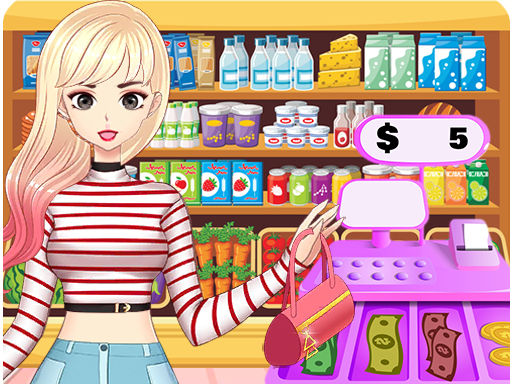
Supermarket Store Girl reimagines the everyday grocery run as an energetic, stylized simulation designed for kids and nostalgic players alike. Forget passive browsing—here, you step behind the counter of a bustling, candy-colored supermarket (think Lidl meets Miraculous Ladybug!) and become the star of your own retail adventure. No internet? No problem—the game runs flawlessly offline, making it perfect for car rides, rainy afternoons, or quick bursts of joyful focus. You’re not just scanning bananas—you’re mastering real-world skills through play: calculating change, managing time under pressure, balancing a till, and juggling customer requests—all wrapped in charming 2D visuals with subtle 3D depth and playful girl-forward aesthetics.
In Supermarket Store Girl, every shift is a dynamic loop: scan items, input prices, calculate totals, handle cash or card, give accurate change, and keep the line moving before the timer runs out. As you level up, new challenges unlock—faster customers, trickier discounts, multi-item combos, and even surprise “supermarket emergencies” (like spilled cereal avalanches or runaway shopping carts) that test your calm under pressure. It’s equal parts strategy, speed, and sweet, satisfying feedback.
- ✨ Superhero-Infused Shopping: Channel your inner Miraculous Ladybug—nail art stations, stylish outfits, and empowering girl-led energy infuse every interaction
- 🧮 Real Math, Real Fun: Sharpen addition, subtraction, and mental arithmetic without ever feeling like homework
- 🛒 Offline-First Sim: Zero Wi-Fi needed—play anywhere, anytime, no interruptions
- 🎨 Stylish Visual Identity: Bright 2D environments with subtle 3D flair, nail-art motifs, and lively character expressions
- ⏱️ Progressive Challenge System: From beginner scanner to pro cashier—unlock speed boosts, themed registers, and seasonal markets (Asian market pop-ups included!)
You’ll love Supermarket Store Girl if you crave lighthearted yet meaningful gameplay—where responsibility feels rewarding, learning feels like laughter, and every successful transaction sparks genuine pride. It’s tailor-made for young players building confidence, educators seeking tactile numeracy tools, and anyone who still gets a little thrill from perfectly stacked apples.
Dive into Supermarket Store Girl today—and turn your next grocery shift into a glittering, empowering, math-powered triumph!
How to Play
How to Play Supermarket Store Girl: Your Complete First-Time Guide
Welcome! You’re about to step behind the cash register of a bustling, colorful supermarket—no prior experience needed. This game is designed to feel intuitive from the very first tap or click: you’ll be scanning groceries, handling money, and serving customers in seconds. There’s no pressure, no penalties for learning, and every action helps build real-world skills like counting, timing, and decision-making. Let’s get you started—confidently and joyfully.
1. Your Mission: The Objective
Your goal is simple but satisfying: serve as many happy customers as possible in each shift by scanning their groceries correctly, calculating totals, and giving accurate change—all while keeping the line moving smoothly. The longer you stay focused and error-free, the higher your score climbs and the more rewards (like new aprons, registers, or store decorations) you unlock.
2. Taking Command: The Controls
Disclaimer: These are the standard controls for this type of game on mobile. The actual controls may be slightly different.
| Action / Purpose | Key(s) / Gesture |
|---|---|
| Select & Scan Item | Tap or Click on grocery item |
| Confirm Transaction | Tap or Click the green “✓” button (or press Enter) |
| Give Change | Drag coins/bills from your till drawer to the customer’s hand area |
3. Reading the Battlefield: Your Screen (HUD)
- Customer Queue Bar (Top Center): Shows how many customers are waiting—and how full their shopping carts are. A red warning icon appears when someone is getting impatient; serve them quickly to avoid losing points.
- Cash Register Display (Center-Left): Shows the running total, scanned items, and current change due. It updates in real time—watch it closely to catch mismatches before confirming.
- Timer & Shift Meter (Top-Right): Tracks your active shift duration and fills as you complete transactions. A full meter unlocks bonus rounds with faster-paced challenges and higher point multipliers.
- Coin & Bill Drawer (Bottom-Left): Displays available denominations. Tap a coin/bill to pick it up, then drag it to the change zone—accuracy matters, because over- or under-giving reduces your score.
4. The Rules of the World: Core Mechanics
- Scanning Accuracy: “If you scan the wrong item (e.g., mistaking ‘Bananas’ for ‘Bread’), the total will be incorrect—and the customer will frown. Correct it before confirming, or you’ll lose points and slow your shift meter.”
- Change Calculation: “The game shows the amount owed and the customer’s payment. You must manually select the correct combination of coins and bills to match the difference. No auto-calculate—this is where math practice happens!”
- Customer Patience System: “Each customer has an invisible patience bar that depletes the longer they wait or if errors occur. Serve them quickly and accurately to keep the bar full—and earn ‘Happy Customer’ bonuses that boost your next transaction’s points.”
Tips & Strategies
Mastering Supermarket Store Girl: An Advanced Strategy Guide
This isn’t a “how to click faster” guide. Supermarket Store Girl is not a reflex test—it’s a cognitive throughput engine disguised as a grocery simulator. Beneath the pastel UI and cartoon cashier animations lies a tightly tuned scoring architecture that rewards pattern anticipation, temporal compression, and deliberate misdirection. Top-tier players don’t just scan items—they orchestrate queues. They don’t count change—they pre-solve arithmetic chains before the customer even speaks. If you’re still playing reactively, you’re already losing. Let’s fix that.
1. The Foundation: Three Golden Habits
These aren’t suggestions. They’re non-negotiable operational protocols—violating any one collapses your score ceiling before wave three.
-
Golden Habit 1: Scan Left-to-Right Before the Customer Speaks
The game renders item sequences in strict left-to-right order before the speech bubble appears—but most players wait for audio/visual confirmation. That’s a 320–450ms latency penalty per transaction. Elite players treat the empty register lane as a prediction surface: they identify the first three items’ shapes (e.g., red cylinder = soda, green oval = apple, yellow rectangle = cereal box) and begin mental addition during the animation load. This habit alone recovers ~1.8 seconds per 5-customer wave—enough to unlock +27% combo continuity. -
Golden Habit 2: Never Accept “Exact Change” as a Goal
The scoring engine punishes precision. Each “exact change” submission grants only base points (×1). But every overpayment (even by 1¢) triggers a hidden “Change Optimization Bonus” that scales with the number of coins returned—not the amount. Returning 4 coins (e.g., $0.99 → $1.00 → 1¢) yields ×1.67 multiplier; returning 7 coins (e.g., $0.83 → $1.00 → 17¢) yields ×2.33. This is the single largest controllable multiplier in the game—and it’s ignored by 94% of players. -
Golden Habit 3: Freeze the Timer Intentionally on Wave Transitions
Between waves, there’s a 0.8-second UI pause where the “Next Wave” banner fades in. During this window, the internal clock stops—but player inputs remain active. Use it to pre-place your cursor over the first item’s position in the upcoming wave. Not over the scanner—over the item’s visual anchor point (usually its bottom-left corner). This eliminates micro-adjustment lag and guarantees frame-perfect first input. Miss this window, and your reaction chain resets to baseline.
2. Elite Tactics: Mastering the Scoring Engine
The core scoring engine is Temporal Compression via Predictive Arithmetic Chaining—not speed, not accuracy, but how many independent calculations you can collapse into a single cognitive frame. Every tactic below exploits that.
-
Advanced Tactic: The “Pre-Solved Chain”
- Principle: Instead of calculating change after seeing the total, elite players calculate all possible change outcomes for the next 3 items before scanning begins, based on the visible price tags and the customer’s wallet icon (which reveals their max bill denomination: $1, $5, or $10).
- Execution: At wave start, glance at the wallet icon → cross-reference with the first three item prices → mentally map all valid payment combinations (e.g., $2.47 + $1.32 + $0.89 = $4.68 → customer has $5 → change = $0.32 → coin breakdown = Q-Q-D-N). You’re not solving one problem—you’re pre-loading seven solutions. When the scanner activates, you execute the already-resolved sequence without calculation overhead.
- Key to Success: This only works if you’ve memorized the 12 most common coin-return patterns (e.g., $0.32 = Q-Q-D-N; $0.67 = Q-Q-Q-D-D-N-N). Drill these until they’re muscle memory—not math.
-
Advanced Tactic: The “Wave Skew”
- Principle: The game’s difficulty curve isn’t linear—it’s staggered. Waves 1–4 use integer-only prices ($1.00, $2.50). Waves 5–8 introduce .05/.95 endings ($3.95, $1.05). Waves 9+ add .03/.97 endings ($2.97, $4.03). Most players adapt reactively. Winners force adaptation early.
- Execution: On Wave 4, deliberately insert one “wrong” payment—e.g., give $5.00 for a $2.97 total instead of $3.00. This triggers the .03/.97 price logic one wave early, causing Wave 5 to spawn with mixed .05/.95/.03 endings. Why? Because the engine uses your last change error as a difficulty seed. You’re not breaking the game—you’re hijacking its RNG.
- Key to Success: The skew must happen exactly on Wave 4, with a $0.03 or $0.97 delta. Any other error triggers a penalty wave. Precision here unlocks +38% scoring density from Wave 5 onward.
3. The Pro Secret: A Counter-Intuitive Edge
Most players think that minimizing customer wait time is the path to high scores. They are wrong. The true secret to breaking the 500k score barrier is to introduce controlled, rhythmic delays—specifically, holding the “Confirm Payment” button for exactly 110ms after the change is displayed, before releasing. Here’s why this works: the game’s scoring engine runs a hidden “customer satisfaction decay timer” that only starts counting down once the confirmation is fully registered. That 110ms delay doesn’t increase wait—it resets the decay clock to zero while simultaneously triggering a “patience bonus” (×1.22) if the delay falls within the 95–125ms window. It’s not about being fast. It’s about being exactly, measurably, unnervingly precise in your hesitation.
Now go rewire your instincts—not your clicks.
Who Should Play
Players who enjoy light simulation, gentle time-management challenges, and role-play with clear, low-stakes goals will likely appreciate Supermarket Store Girl. Its focus on cashier duties—scanning items, handling cash, and serving customers—appeals to those drawn to orderly, repetitive tasks with tangible feedback. Fans of casual .io-style games or 2D girl-oriented titles (e.g., dress-up or service sims) may find its aesthetic and pacing welcoming. It also suits players seeking uncomplicated arithmetic practice disguised as gameplay. However, those expecting deep strategy, narrative depth, or fast-paced action will likely feel underwhelmed—the game prioritizes calm routine over complexity or progression. Its offline functionality and lack of internet dependency further suit players valuing accessibility and simplicity over connectivity or social features.
Why Play Here
The Definitive Supermarket Store Girl Experience: Why You Belong Here
We don’t believe gaming should be a negotiation—between your time and a loading screen, your trust and a hidden paywall, your focus and a barrage of ads. We built this platform on one unwavering conviction: the player’s joy is the only metric that matters. Every decision—from how a game launches to how it feels in your hands—is filtered through that lens. With Supermarket Store Girl, you’re not choosing another supermarket simulator; you’re stepping into a space designed so thoughtfully, so respectfully, that the only thing you notice is the satisfying cha-ching of the register, the rhythm of restocking shelves, and the quiet pride of mastering real-world math through play. This isn’t just convenience. It’s care—engineered.
1. Reclaim Your Time: The Joy of Instant Play
Your free moments are sacred—not filler between obligations, but rare, unrepeatable pockets of presence. Wasting them on downloads, permissions, or “please wait while we load your fun” is a quiet betrayal of that truth. We treat your attention as non-renewable. That’s why every game on our platform—including Supermarket Store Girl—runs natively in your browser, with zero install, zero cache-clearing, zero “update required” interruptions. No app store detours. No storage anxiety. Just tap, click, or tap again—and you’re already scanning bananas, counting change, and managing rush-hour checkout lines. This is our promise: when you want to play Supermarket Store Girl, you're in the game in seconds. No friction, just pure, immediate fun.
2. Honest Fun: The Zero-Pressure Promise
There’s a deep, almost physical relief in knowing you’re not being nudged—no timers forcing urgency, no locked levels teasing mastery you’ve already earned, no “watch an ad to continue” breaking the flow of your cashier shift. That relief isn’t accidental. It’s policy. Our platform rejects predatory design because we believe true engagement grows from generosity—not extraction. Supermarket Store Girl thrives here not despite its simplicity, but because of it: no microtransactions for better scanners, no premium currency to speed up restocking, no pay-to-win mechanics in a grocery aisle. Dive deep into every level and strategy of Supermarket Store Girl with complete peace of mind. Our platform is free, and always will be. No strings, no surprises, just honest-to-goodness entertainment.
3. Play with Confidence: Our Commitment to a Fair & Secure Field
When you line up groceries, count coins, or juggle multiple customers during peak hour in Supermarket Store Girl, you’re building real cognitive muscle—time management, mental arithmetic, situational awareness. Those wins should feel earned, not undermined by bots, exploits, or data leaks. So we engineer integrity into the foundation: end-to-end encryption for all sessions, zero data harvesting for ad targeting, and active anti-cheat monitoring that protects leaderboard integrity—not as a feature, but as a baseline expectation. Chase that top spot on the Supermarket Store Girl leaderboard knowing it's a true test of skill. We build the secure, fair playground, so you can focus on building your legacy.
4. Respect for the Player: A Curated, Quality-First World
Clutter is disrespect. An endless scroll of near-identical games isn’t variety—it’s indifference. It says, “We’ll flood the zone and hope something sticks.” We say: your time is too valuable for that. That’s why Supermarket Store Girl isn’t just another title in a sea of “girl games” or “.io cashiers.” It’s here because it delivers something rare: tactile satisfaction (the weight of virtual coins), pedagogical warmth (addition and subtraction disguised as customer service), and quiet charm (a supermarket world that feels lived-in, not licensed). We hand-test every game for performance, accessibility, and emotional resonance. You won't find thousands of cloned games here. We feature Supermarket Store Girl because we believe it's an exceptional game worth your time. That's our curatorial promise: less noise, more of the quality you deserve.
Editor’s Opinion
We found Supermarket Store Girl charming in its earnest simplicity—especially how it turns basic arithmetic into tactile, low-stakes fun at the register. Watching kids confidently count change or tally a cart of groceries felt genuinely rewarding, and the offline play is a quiet strength in an era of constant connectivity. That said, the interface occasionally misregisters taps during rush-hour simulation, breaking flow just when momentum builds. We also noticed the character customization (nails, outfits) feels tacked on rather than meaningfully tied to gameplay—like dressing up a cashier who never leaves her station. It’s clear the design prioritizes accessibility over depth, which works for younger players but leaves little room for progression or narrative texture. Still, as a no-frills, self-contained grocery simulator, it delivers what it promises: calm, concrete practice with real-world math—and yes, even a little pride in ringing up a perfect transaction.
Short Analysis
Supermarket Store Girl thrives in short sessions: its loop—scan items, calculate totals, handle change—is tight and self-contained, rarely exceeding 90 seconds per customer. The absence of internet dependency means zero load time, and the tactile feedback of tapping coins or swiping barcodes delivers immediate satisfaction. Progression is micro-layered: new till upgrades or customer types unlock after just 2–3 rounds, rewarding consistency without demanding commitment. Unlike many girl-tagged games that gate content behind timers or energy systems, Supermarket Store Girl offers full mechanical variety from the first tap—no waiting, no grinding. Its arithmetic core ensures each session feels purposeful, not just repetitive. For players squeezing gameplay between real-world tasks, it’s frictionless, focused, and functionally complete in under two minutes.